
Author: Emilie Terne, LL.M. Candidate ‘Criminology, Criminal Justice and Human Rights’
(Criminal Justice and Human Rights Clinic), University of Galway
Smoking is deeply embedded in prison culture across Europe [1]. As 2022 data from the World Health Organisation show, smoking is a habit that involves, on average, 63.1% of the prison population in Europe [2]. In some cases, such as for male prisoners in France, the figures were significantly higher, reaching about 90% [3]. The reasons for smoking range from finding a ‘social common ground’ [4] to calming the nerves [5], coping with stress [6] and combating boredom [7]. Cigarettes may also serve as a form of currency [8].
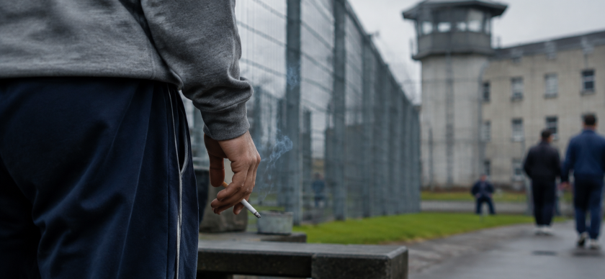
Such a high proportion of smokers often leads to ‘high exposure to second-hand smoke in prisons’ [9] and associated increased health risks [10] for other prisoners, as well as staff and visitors who may not smoke themselves [11]. Because prisons are closed institutions, non-smokers are more vulnerable than they would be in the wider community [12]. Other risks associated with smoking in prison relate to fire safety [13] and ‘violence and inequalities between inmates’ [14]. Lighters may also be used to inflict self-harm [15].
With special consideration of health protection, some European countries have introduced total or partial smoking bans in prison [16]. Even though there is no uniformity in Europe [17], a study carried out in 2024 found that in the Council of Europe member states that were part of the study, smoking in prison was permitted – albeit subject to certain conditions [18].
Even though the transformation to a smoke-free prison can proceed ‘smoothly’ (as for example the one in England was described [19]), total smoking bans may create risks, such as:
- Well-being of smoking prisoners:
- ‘Increased prisoner distress’ [20]
- Self-harm [21]
- Prison safety:
- ‘Violence, or riots’ [22]
- Increased risk of injury to staff [23]
- Creation of black markets [24]:
- Increased prices and debt of prisoners [25]
- Use of other potentially more dangerous [26] or more difficult to detect [27] drugs
- More emergencies because of other drugs’ consumption [28]
- Use of dangerous ignition sources [29]
- Increased disciplinary issues
The banning of cigarettes may, for example, lead to the creation of a black market [30] which could be connected to higher prices and therefore possible debt for prisoners who nevertheless wish to smoke [31]. For example, a study in a prison in England has found ‘a small 30g pouch of rolling tobacco to be worth around £500’ [32].
In addition to the risks, it is uncertain whether smoking bans can reach their goal of protecting non-smokers in prison, as it may become more difficult for them to report smoking due to an unofficial rule not to ‘rat’ on other prisoners [33]. On the other hand, if breaches of bans are detected, they are likely to have a negative impact on prisoner rehabilitation [34] and therefore their release, which in turn may have a financial impact on the state, as prisoners may remain in detention for longer than anticipated [35].
European Human Rights and Penal Policy
Council of Europe Treaty Law
From the European Social Charter arises a responsibility to protect prisoners’ health (Article 11) and to ensure safe working conditions (Article 3) [36].
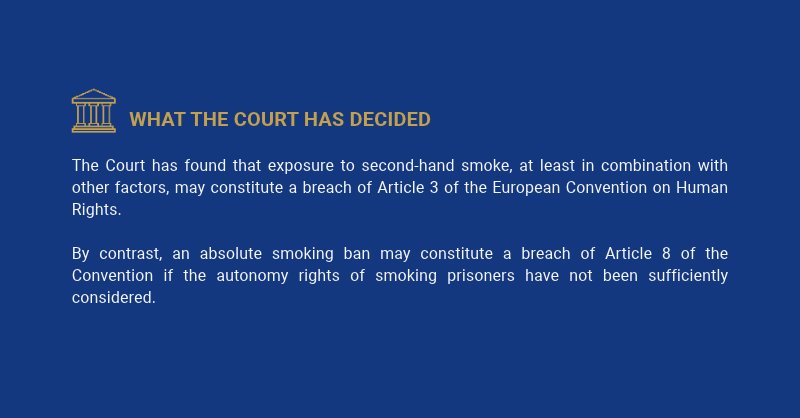
As there is no direct protection of health, the European Court of Human Rights mainly considered Article 3 (prohibition of torture), Article 8 (right to respect for private and family life) [37] and Article 2 (right to life) [38] of the European Convention on Human Rights when dealing with smoking in prisons. Whilst exposure to second-hand smoke may constitute a breach of Article 3, the Court has typically based such a finding on a combination of several factors rather than exposure by itself [39]. Such factors include overcrowding [40] or specific health factors [41]. In Aparicio Benito v. Spain (dec), the Court found no violation of Article 3 as smoking was only permitted in common areas [42].
From the viewpoint of smoking prisoners, the European Court of Human Rights considered the total smoking ban in Estonia as not being in violation of Article 3 of the European Convention on Human Rights [43], but that it constituted a violation of Article 8 of the Convention instead. It held that the rights to autonomy of smoking prisoners were not considered in the face of such a far-reaching restriction [44]. However, following the removal of the complaint from the register at the request of the Estonian Government, the judgment has no legal effect (‘legally void’) [45].
European Prison Rules
The European Prison Rules do not contain any explicit provisions on smoking and vaping in prisons. Nevertheless, they provide a framework against which prison authorities can base their regulations.
Under the European Prison Rules, prison authorities have a responsibility to protect the health of prisoners [46], especially regarding their (shared) accommodation [47]. According to Rules 40.2 and 52.5, particular account should be taken of the national health strategy, provided that it is compatible with prison conditions. This may also include national tobacco control strategies and occupational health and safety regulations protecting prison staff.
On the other hand, the European Prison Rules also recognise that, apart from the deprivation of their liberty, prisoners retain their autonomy [48], and that restrictions must be both as limited as possible and proportionate [49].
In case of the implementation of a smoking ban, other recommendations in the European Prison Rules may also be relevant, such as the need for health screenings upon admission [50] and the role of staff as role models [51].
European Union
Similarly, the Council of the European Union has emphasised that prisons are not only places where prisoners live, but also workplaces, and that staff must therefore be protected from second-hand smoke [52].
How Can Prison Administrations Achieve a Balance?
In their attempts to achieve balance between differing interests, various countries have produced a wide range of solutions.
Practical Examples
Especially where a total smoking ban is enforced, e-cigarettes are often seen as an alternative or a means to help prisoners to quit smoking [53] and therefore remain permitted. In Scotland, a total ban on smoking has been in force since 2018 [54]. To ensure that smoking prisoners continue to have access to nicotine, the use of vapes remains permitted with specific restrictions to protect people affected [55]. A study found that second-hand smoke dropped by an average of 81% across Scottish prisons following the ban [56].
In Belgium, on the other hand, smoking is permitted for prison staff in specific areas and for prisoners in their cells or outdoors [57]. The protection of non-smoking prisoners from second-hand smoke is achieved through complaints commissions. For example, in 2026, a complaints commission deemed the housing of a non-smoker with a smoker to be a violation of the prisoner’s rights due to the health risks involved [58].
Sweden has opted for a middle ground with a partial smoking ban: in Swedish prisons smoking is only allowed outdoors at times and in places designated by the Prison and Probation Service [59]. However, during implementation, prisoners had to be prevented from smuggling cigarettes indoors [60].
Suggestions
When making decisions regarding smoking and vaping, prison authorities must take a wide range of interests into account. These include the human rights of all affected, as well as the specific operational requirements and security risks within prisons. Whilst total smoking bans may be problematic in relation to the autonomy of smoking prisoners, a complete lack of regulation usually offers insufficient protection against second-hand smoke. Even with partial smoking bans, which can take various forms (for example, indoor smoking bans, smoking permitted only in cells [61]), health risks remain a concern [62].
Nevertheless, partial smoking bans may be a way of achieving a balance between various rights, provided they offer sufficient protection. In this context, it may be worth considering the following:
- If smoking is only allowed in specific areas of the prison, this could reduce indoor smoke and fire risks
- Provision of special ventilation systems if smoking is permitted in cells [63]
- Provision of sufficient smoke-free cells
- No exposure to second-hand smoke of vulnerable groups (e.g. pregnant women, prisoners with particular illnesses) [64]
- Provision of nicotine substitution products
- Implementation of programmes that help prisoners quit smoking
- Whilst vaping may reduce exposure to second-hand smoke, it may, however, pose other risks (e.g. use for psychoactive substances, which may be more dangerous and harder to detect [65])
Lastly, if we consider the reasons why prisoners smoke, mental health support and the provision of meaningful activities (e.g. work, physical activity) [66] may also help to reduce smoking in prison.
Cited Sources
1See also Susan MacAskill and others, ‘Social marketing with challenging target groups: smoking cessation in prisons in England and Wales’ (2008) 13 International Journal of Nonprofit and Voluntary Sector Marketing 251, 253; Ashley Brown and others, ‘Prison Staff and Prisoner Views on a Prison Smoking Ban: Evidence From the Tobacco in Prisons Study’ (2019) Nicotine & Tobacco Research 1027, 1027.
2World Health Organisation (WHO) Regional Office for Europe, Status report on prison health in the WHO European Region 2022 (2023), xiii, 51.
3World Health Organisation (WHO) Regional Office for Europe, Tobacco use in prisons (2022), 1.
4Catherine Ritter and others, ‘Smoking in prisons: The need for effective and acceptable interventions’ (2011) 32 Journal of Public Health Policy 32, 38.
5Ritter and others (n 4) 37.
6Ritter and others (n 4) 40; see also Robyn L. Richmond and others, ‘Promoting smoking cessation among prisoners: feasibility of a multi-component intervention’ (2006) 30 Australian and New Zealand Journal of Public Health, 474, 474; WHO, Tobacco use in prisons (n 3) 4.
7Ritter and others (n 4) 38; World Health Organisation (WHO), ‘Tobacco use in prisons: a neglected public health issue’ <https://www.who.int/europe/news/item/09-05-2022-tobacco-use-in-prisons–a-neglected-public-health-issue> accessed 6 October 2026; see also Richmond and others (n 6) 474, 476; WHO, Tobacco use in prisons (n 3) 4.
8Ritter and others (n 4) 37 f.; see also European Committee for the prevention of torture and inhuman or degrading treatment or punishment, Prison Standard Informal prisoner hierarchy (CPT/Inf (2025) 12) 9; Ashley Brown and others (n 1) 1028.
9WHO, Tobacco use in prisons (n 3) 2; see also European Committee for the Prevention of Torture and inhumane or degrading treatment or punishment, Visit report Cyprus April 2025 (CPT/Inf (2025) 39) 13 para 32; WHO (n 7); Niluka Gamalath,’ A Study on the Right to Health of Prisoners: Jurisprudence of the European Court of Human Rights’ (2023) <https://papers.ssrn.com/sol3/papers.cfm?abstract_id=5073273> accessed 6 October 2026, 3; Heino Stöver, ‘Tobacco use in prison settings: A need for policy implementation’ (Expert blog PRI, 15th August 2018) <https://www.penalreform.org/blog/tobacco-use-in-prison-settings-a-need-for/> accessed 6 October 2026.
10WHO, Tobacco use in prisons (n 3) 2; see also WHO (n 7); Gamalath (n 9) 3; Stöver (n 9).
11Dr Paul Gray and Dr Rob Ralphs, ‘Harm reduction or a catalyst for new harms? The impact of smoke-free prison policy on prisoners and the prison regime’ <https://repository.mmu.ac.uk/articles/journal_contribution/Harm_reduction_or_a_catalyst_for_new_harms_The_impact_of_smoke-free_prison_policy_on_prisoners_and_the_prison_regime/32458119?file=65024904> accessed 6 October 2026.
12Elise Maes, ‘Legal implications of smoking (bans) in English prisons’ (2019) 39 Legal Studies 321, 329.
13See also Leah Jayes and others, ‘A Qualitative Study of the Implementation and Continued Delivery of Complete and Partial Smoke-Free Policies Across England’s Prison Estate’ (2023) 25 Nicotine and Tobacco Research 1099, 1101 (perceived reduction in fires following the introduction of the smoking ban in English prisons).
14Ahmad Khalaf, ‘Smoking, prisons and human rights’ <https://pmc.ncbi.nlm.nih.gov/articles/PMC10366707/> accessed 6 October 2026.
15See for example Irish Prison Service, 2024 Report: Self-harm in Irish Prisons (2025) 28 regarding fire or flames used to inflict self-harm.
16See also Jayes and others (n 13) 1099.
17See also European Court of Human Rights (ECtHR), Guide on the case-law of the European Convention on Human Rights, Prisoner’s Rights, 43 para 179.
18Referred to in Vainik and Others v Estonia App nos. 17982/21 and 3 others (ECtHR, 4 November 2025) 17 para 88; see also WHO, status report (n 2) 31.
19Jayes and others (n 13) 1101.
20Brown and others (n 1) 1031.
21Brown and others (n 1) 1031.
22Brown and others (n 1) 1031.
23Brown and others (n 1) 1031.
24Dr Paul Gray and Dr Rob Ralphs (n 11); Irish Penal Reform Trust (IPRT), ‘Prison smoking ban would cause more problems than it would solve, says IPRT’ (5th May 2006) <https://www.iprt.ie/latest-news/prison-smoking-ban-would-cause-more-problems-than-it-would-solve-says-iprt/> accessed 6 October 2026; see also Ritter and others (n 4) 39; Maes (n 12) 336.
25See also Gray and Ralphs (n 11).
26Gray and Ralphs (n 11); see also Maes (n 12) 336 f.
27Jayes and others (n 13) 1104.
28Gray and Ralphs (n 11).
29Brown and others (n 1) 1031.
30Gray and Ralphs (n 11); IPRT (n 24); see also Ritter and others (n 4) 39; Maes (n 12) 336.
31See also Gray and Ralphs (n 11).
32Gray and Ralphs (n 11).
33Maes (n 12) 336.
34Ritter and others (n 4) 39.
35See also IPRT (n 24).
36European Social Charter (revised) (ETS No. 163).
37See also Maes (n 12) 328 ff.
38Aparicio Benito v Spain App no 36150/03 (ECtHR, 13 November 2006) 5 f.
39See ECtHR, Guide Prisoner’s Rights (n 17) 44 para 182; see also Maes (n 12) 326 f.
40Ostrovar v Moldova App no 35207/03 (ECtHR, 13 September 2005) 17 f. paras 82 – 84, 19 para 89.
41Ostrovar v Moldova (n 40) 15 para 85, 19 para 89; for other cases see also ECtHR, Guide Prisoner’s Rights (n 17) 43 para 180 f.
42ECtHR, Guide Prisoner’s Rights (n 17) 43 para 180.
43Vainik and Others v Estonia (n 18) 25 para 127.
44Vainik and Others v Estonia (n 18) 25-27 paras 128-133, 34 f. paras 172 f.
45Vainik and Others v Estonia (striking out) App nos. 17982/21 and 2 others (ECtHR (GC), 30 June 2026) 8 paras 39 f.
46Council of Europe, European Prison Rules, Recommendation Rec(2006)2-rev, Rule 39.
47European Prison Rules (n 46) Rules 18.1, 18.6.
48See European Prison Rules (n 46) Rule 2.
49European Prison Rules (n 46) Rule 3.
50European Prison Rules (n 46) Rule 42.1.
51European Prison Rules (n 46) Rule 75.
52Council of the European Union Recommendations Council, ‘Council Recommendation of 30 November 2009 on smoke-free environments (2009/C 296/02)’ Official Journal of the European Union para 21; see also Art. 31 (1) Charter of Fundamental Rights of the European Union (2000/C 364/01).
53Jayes and others (n 13) 1105.
54Prisons and Young Offenders Institutions (Scotland) Amendment Rules 2018; see also Tobacco and Vapes Act 2026 (Consequential, Transitional and Saving Provisions) (Scotland) Regulations 2026.
55Rule 36 of The Prisons and Young Offenders Institutions (Scotland) Rules 2011; see also Prisons and Young Offenders Institutions (Scotland) Amendment Rules 2018; Tobacco and Vapes Act 2026 (Consequential, Transitional and Saving Provisions) (Scotland) Regulations 2026; see also Jayes and others (n 13) 1105.
56Sean Semple and others, ‘The impact of implementation of a national smoke-free prisons policy on indoor air quality: results from the Tobacco in Prisons study’ (2020) 29 Tob Control, 234, 234 f.
57WHO, Status report (n 2) 116.
58Klachtencommissie Haren (Prison Complaints Committee), Decision of 19 August 2026 (CP36/26-0207).
59§ 25 Kriminalvårdens föreskrifter om ändring i Kriminalvårdens föreskrifter och FARK Fängelse allmänna råd (KVFS 2011:1) om fängelse; § 4(4) Fängelseförordning (2010:2010).
60JO Riksdagens Ombudsmän, The Swedish Parliamentary Ombudsmen, Annual report 2018/19: Summary in English, 67 f.
61See Vainik and Others v Estonia (n 18) 17 para 90 f.
62See also Ritter and others (n 4) 39.
63See also European Prison Rules (n 46) Rule 44c.
64See also European Committee for the prevention of torture and inhuman or degrading treatment or punishment, Prison Standard Healthcare in prison (CPT/Inf (2025) 37) 21 para 85.
65Jayes and others (n 12) 1104.
66See also WHO, Tobacco use in prisons (n 3) 4; Stöver (n 9); Gray and Ralphs (n 11).