

Author: Emilie Terne, LL.M. Candidate ‘Criminology, Criminal Justice and Human Rights’
(Criminal Justice and Human Rights Clinic), University of Galway
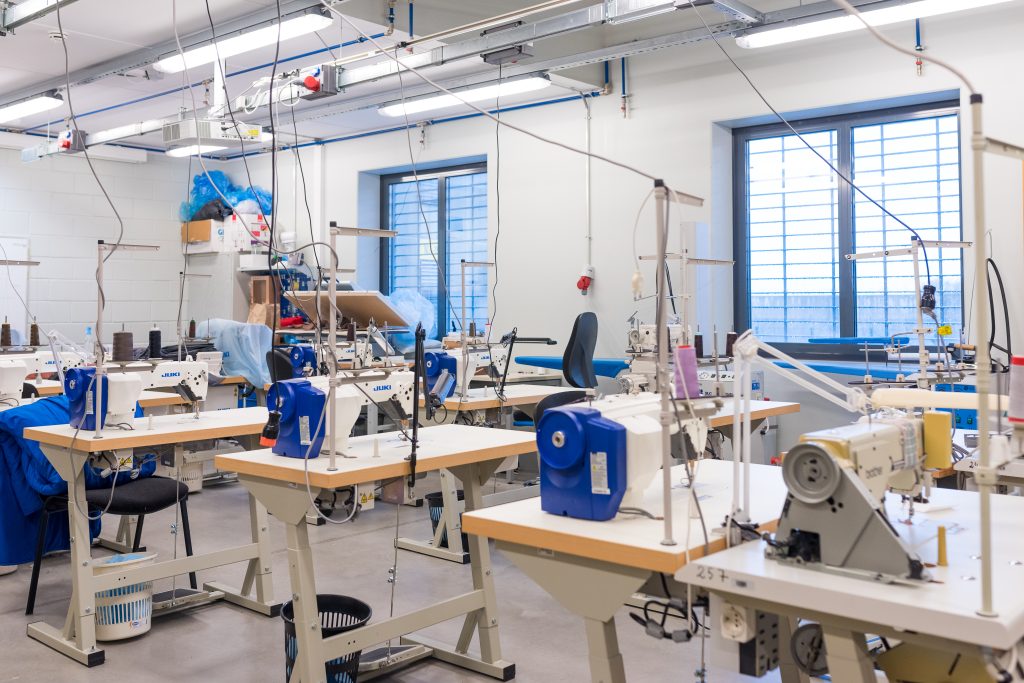
Prison work is a key component in the organisation of European prisons and can cover a wide variety of tasks carried out by prisoners. Unlike employment outside of prison, prison work takes place within an institutional setting and is organised differently as a result. This may be reflected in access to work and working conditions. Drawing on interviews with prisoners, Penal Reform International finds that prisoners wish to work (PRI, Prison Work, p. 28), even though this opportunity may not be always available (PRI and Thailand Institute of Justice, Global Prison Trends 2026, p. 36).
For European prisoners the question remains: should prison work be regarded as a right or an obligation in prison? Compulsory prison work is the norm for sentenced prisoners in most countries worldwide (UN Human Rights Council, A/HRC/57/46 (2024), paras. 6, 50; PRI, Prison Work, p. 19): a position permitted by contemporary practice. In Europe, a comparative assessment of national legislation, to which the European Court of Human Rights referred in 2011, showed that in 25 of the 40 Council of Europe member states considered, people were, ‘at least in certain circumstances, required to work’ (Stummer v. Austria (ECtHR, 2011), para. 60(a)).
Meaningful activities are essential for prisoners’ mental wellbeing (CPT, 30th General Report (2021), p. 40). Work can help to structure the daily lives of prisoners, maintain their personal autonomy by providing them with the financial means to meet their basic needs (CPT, 30th General Report (2021), p. 40) and play a significant role in preparing prisoners for life after release (PRI, Prison Work, pp. 7, 21, 44; European Prison Rules, rr. 6, 102.1). Through all these effects, work can be beneficial for prisoners. Conversely, the lack of work and poor working conditions can undermine the guarantee of a humane prison routine.
Requirements of the European legal framework
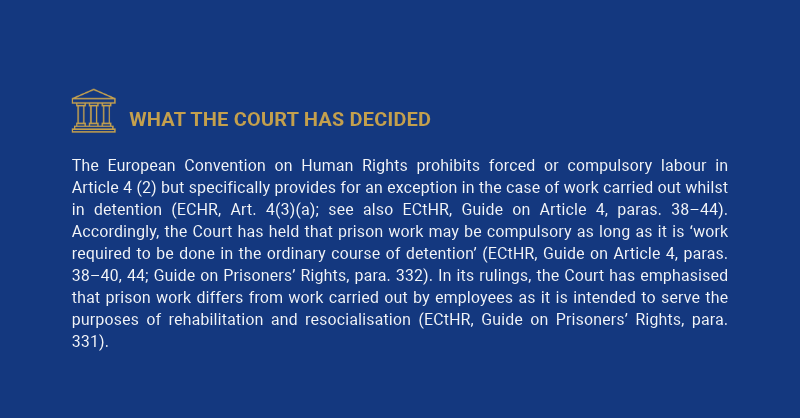
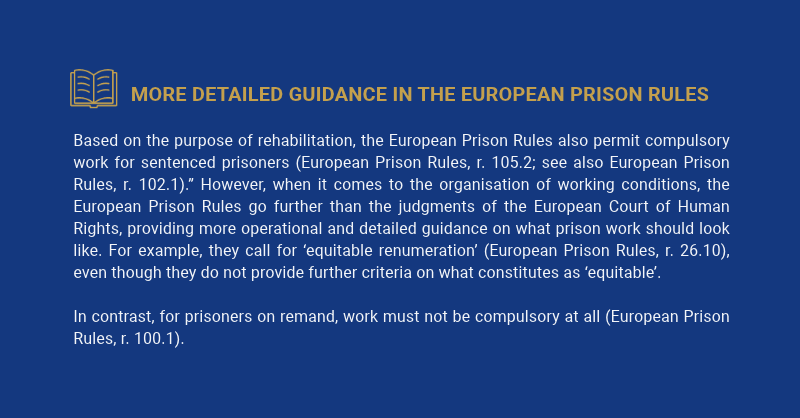
At the Council of Europe level, guidance on prison work and its compliance with human rights standards comes primarily from two sources: the case law of the European Court of Human Rights (ECtHR, De Wilde, Ooms and Versyp v. Belgium (1971); Van Droogenbroeck v. Belgium (1982); Stummer v. Austria (2011); Zhelyazkov v. Bulgaria (2012); Floroiu v. Romania (2013); Meier v. Switzerland (2016)) and the European Prison Rules. While all 46 Council of Europe member states are currently parties to the European Convention on Human Rights, the Court’s jurisdiction derives from states’ ratification of the Convention rather than their membership of the Council of Europe.
Judgments of the European Court of Human Rights are binding on the states concerned and must be implemented accordingly. By contrast, the European Prison Rules are recommendations adopted by the Committee of Ministers. While not legally binding, they serve as an important benchmark for prison policy and practice across Europe.
In line with these requirements, the European Commission emphasises, for the member states of the European Union, that prison work serves the purpose of ‘social reintegration’ (European Commission, Recommendation C(2022) 8987 final, p. 14) and is one way of giving prisoners the opportunity to spend ‘time outside their cells’ (European Commission, Recommendation C(2022) 8987 final, p.14 para. 46). However, it is not made clear whether prison work is then deemed compulsory or work that should be provided (European Commission, Recommendation C(2022) 8987 final, paras. p.14 46–47)) then constitutes a right for prisoners.
Good Practice in accordance with Human Rights
As human rights law centres social rehabilitation as the objective for penal policy (ICCPR, Art. 10(3); European Prison Rules, rr. 6, 102.1, 105.1), it is preferable not to compel prisoners to work, but rather to offer them work as a positive incentive.
Even though prison work may be made compulsory under European regulations, it is preferable to structure it as a positive incentive.
Examples and their limits
France and the Netherlands no longer treat prison work as an obligation. Whilst prisoners in France are free to choose which reintegration-focused activities they undertake (French Code pénitentiaire, Arts. L411-1, R411-1), prison work in the Netherlands is organised on a ‘voluntary’ basis (Dutch Penitentiaire beginselenwet, Art. 47(1); Regeling model huisregels penitentiaire inrichtingen, r. 3.2; CPT Netherlands Report (2023), para. 105). Nevertheless, de facto pressure remains possible, as refusing to work may result in other negative consequences (Dutch Prison House Rules, r. 3.2; CPT Netherlands Report (2023), para. 116; Noorda (2024), p. 467).
Belgium, by contrast, has established prison work as a right, albeit one limited by the actual availability of jobs (Belgian Loi de principes concernant l’administration pénitentiaire, Art. 81). When prison work is regarded as a right, the state also has an obligation to offer it to prisoners who are willing to undertake it. Otherwise, prison work degenerates into a privilege enjoyed by the few, rather than a right (Noorda (2024), p. 473).
Such a duty to take necessary measures to enable prisoners who so request to engage in work is provided for, for example, in French, Dutch and Belgian regulations (French Code pénitentiaire, Art. L412-1; Dutch Penitentiaire beginselenwet, Art. 47(2); Dutch Regeling model huisregels penitentiaire inrichtingen, House Rule 3.2; Belgian Loi de principes concernant l’administration pénitentiaire, Art. 82).
Nevertheless, in reality, the number of jobs available may often remain limited: e.g., in France, only 28.5 % of its prison population is at work (PRI, Prison Work, p. 15; see also CPT France Visit Report (2026), paras. 108 f).

As prisoners have a right to humane and safe detention conditions (CPT, 30th General Report (2021), p. 35), work and working conditions must be organised in a compatible manner, whilst at the same time considering the specific security requirements (see also European Commission, Recommendation C(2022) 8987 final, p.14 para. 46; PRI, Prison Work, pp. 20, 38, 44; ECtHR, Guide on Prisoners’ Rights, para. 331) of a prison. In accordance with the principle of normalisation (European Prison Rules, r. 5) and the aim of rehabilitation, prison work should, as far as possible, provide conditions comparable to those of work outside prison (European Prison Rules, r. 26.7; Council of Europe, Commentary (2020), p. 18).
Prison systems should ensure that work performed in custody functions as meaningful employment that supports the individual in different ways. In order to do so prison work should be moved closer to ordinary work life.
In accordance with the European Prison Rules, this can mean:
- Paying working prisoners equitable remuneration (European Prison Rules, rr. 26.10, 100.2; CPT, 30th General Report (2021), p. 40; PRI, Prison Work, p. 44). Criteria may be based not only on wages outside prison (Council of Europe, Commentary to European Prison Rules (2020), p. 18) but also on the cost of a decent standard of living within prison (PRI, Prison Work, p. 45).
- Conducting work under decent working conditions (European Prison Rules, r. 105.3; PRI, Prison Work, p. 44) and with due regard for health and safety standards (European Prison Rules, r. 26.13; Council of Europe, Commentary (2020), p. 18; PRI, Prison Work, p. 45; see also European Prison Rules, r. 105.3; European Prison Observatory, Prison in Europe: overview and trends (2013), p. 28).
- Providing work that is meaningful and, ideally, of benefit to prisoners even after their release (European Prison Rules, rr. 26.2, 26.7, 100.2; PRI, Prison Work, p. 44; European Commission (2022), p.14 para. 47).
- Other employment rights should also be applied, for example, with regard to working hours, holiday entitlement, and access to social security systems (European Prison Rules, rr. 26.15–26.17; Council of Europe, Commentary (2020), p. 18; see also European Prison Rules, r. 105.3).
- Opting to work should not result in the exclusion of other activities (such as education) (European Prison Rules, rr. 26.16, 100.2; Council of Europe, Commentary (2020), p. 18).
Other suggested actions could include:
- Making work equally available to all prisoners (CPT, 30th General Report (2021), p. 40; see also European Prison Rules, r. 26.4 regarding discrimination on the basis of gender in the type of work provided, taking into account their physical and mental condition (European Prison Rules, r. 105.2).
- The establishment of an independent oversight mechanism to ensure that working conditions remain fair, safe and properly regulated (PRI, Prison Work, pp. 27, 30, 44).
However, the responsibility for implementing the recommendations outlined in this Human Rights Spotlight, should not rest solely with prison authorities. States must also provide the necessary legal framework, resources and support to enable their effective implementation.
Cited Sources
Books, Reports, Journal Articles and Institutional Publications
- Council of Europe (2020) European Prison Rules. Recommendation Rec(2006)2-rev.
- Council of Europe (2020) Commentary to Recommendation Rec(2006)2-rev of the Committee of Ministers to member States on the European Prison Rules. CM(2020)17-add2.
- European Commission (2022) Commission Recommendation of 8 December 2022 on procedural rights of suspects and accused persons subject to pre-trial detention and on material detention conditions. C(2022) 8987 final.
- European Committee for the Prevention of Torture and Inhuman or Degrading Treatment or Punishment (CPT) (2021) 30th General Report of the CPT. CPT/Inf (2021) 5.
- European Committee for the Prevention of Torture and Inhuman or Degrading Treatment or Punishment (CPT) (2023) Report to the Government of the Netherlands on the periodic visit to the Kingdom of the Netherlands carried out by the CPT from 10 to 25 May 2022. CPT/Inf (2023) 12.
- European Committee for the Prevention of Torture and Inhuman or Degrading Treatment or Punishment (CPT) (2026) Rapport de visite France septembre–octobre 2024. CPT/Inf (2026) 02.
- European Court of Human Rights (ECtHR) (updated 2026) Guide on Article 4 of the European Convention on Human Rights: Prohibition of slavery and forced labour.
- European Court of Human Rights (ECtHR) (updated 2026) Guide on the case-law of the European Convention on Human Rights: Prisoners’ rights.
- European Prison Observatory (2013) Prison in Europe: Overview and trends.
- Noorda, H. (2024) ‘“Voluntary” prison labour in the Netherlands’, European Labour Law Journal, 15(3), p. 465-476
- Penal Reform International (PRI) (2026) Prison work: A guide to regulated and rehabilitative-based approaches – informed by lived experience.
- Penal Reform International and Thailand Institute of Justice (2026) Global Prison Trends 2026.
- United Nations Human Rights Council (2024) Contemporary forms of slavery as affecting currently and formerly incarcerated people: Report of the Special Rapporteur on contemporary forms of slavery, including its causes and consequences, Tomoya Obokata. 19 July. UN Doc. A/HRC/57/46.
Case Law
- De Wilde, Ooms and Versyp v Belgium (1971) Applications nos. 2832/66, 2835/66 and 2899/66, ECtHR, 18 June.
- Floroiu v Romania (2013) Application no. 15303/10, ECtHR (decision), 12 March.
- Meier v Switzerland (2016) Application no. 10109/14, ECtHR, 9 February.
- Stummer v Austria (2011) Application no. 37452/02, ECtHR (Grand Chamber), 7 July.
- Van Droogenbroeck v Belgium (1982) Application no. 7906/77, ECtHR, 24 June.
- Zhelyazkov v Bulgaria (2012) Application no. 11332/04, ECtHR, 9 October.
Legislation and International Instruments
- Belgium (2005) Loi de principes concernant l’administration pénitentiaire ainsi que le statut juridique des détenus. Articles 81–82.
- Council of Europe (1950) European Convention on Human Rights. Article 4(3)(a).
- France (n.d.) Code pénitentiaire. Articles L411-1, L412-1 and R411-1.
- Netherlands (n.d.) Penitentiaire beginselenwet. Article 47(1)–(2).
- Netherlands (n.d.) Regeling model huisregels penitentiaire inrichtingen. House Rule 3.2.
- Netherlands, Tweede Kamer (2018–2019) Kamerstukken II 2018/19, 35 122, Nr. 3.
- United Nations (1966) International Covenant on Civil and Political Rights. Article 10(3).