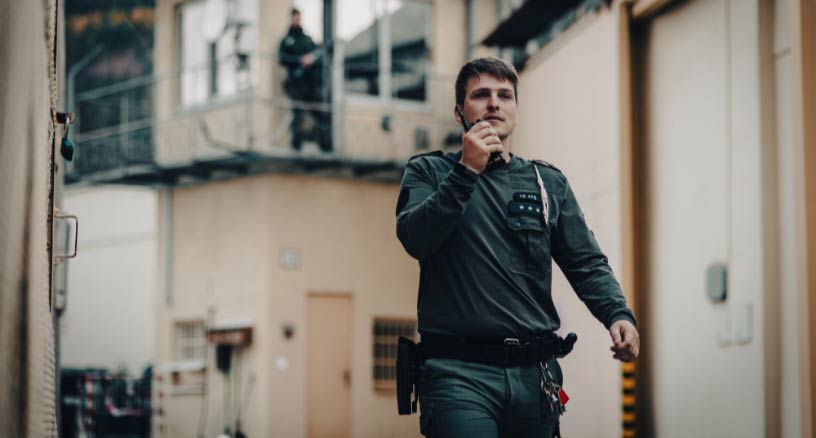
A brief overview of why this topic matters for staff wellbeing in prison services.
Prisons are complex environments delivering security, daily care, rehabilitation, education, health services and family contact within tightly controlled and enclosed spaces. As such, this means that lighting, ventilation, acoustics, movement routes, sightlines and staff‑only areas have a direct impact on staff stress, comfort, safety and their ability to perform duties effectively.
Optional ideas informed by the EuroPris Staff Wellbeing Expert Group to help you explore the topic further and adapt approaches to your own prison service.
Enhance lighting design to support alertness and reduce visual fatigue (e.g., secure natural light, clerestory glazing or task‑focused lamps).
Introduce acoustic and visual privacy measures to reduce noise stress and support concentration (e.g., sound‑absorbing panels or screened staff desks).
Plan circulation routes effectively to ease congestion and reduce operational pressure (e.g., staff‑only corridors and clear wayfinding).
Upgrade visiting facilities to promote dignity and support morale (e.g., accessible layouts, comfortable seating and improved hygiene).
Incorporate natural elements to reduce stress and aid recovery (e.g., internal planting, small gardens or views to outdoor spaces).
Adopt less intrusive security technologies to maintain safety respectfully (e.g., scanners and CCTV to reduce manual searching).
Improve ventilation and thermal control to maintain environmental comfort (e.g., regular servicing of heating and cooling systems).
Provide ergonomic workstations to reduce physical strain (e.g., adjustable desks and supportive seating).
Create quiet recharge spaces to promote psychological recovery (e.g., privacy rooms with hydration and basic kitchen amenities).
Offer on‑site exercise options to support wellbeing (e.g., small gyms or multipurpose rooms for stretching and fitness).
Designate accessibility/disability leads to promote inclusive environments (e.g., regular reviews of adjustments and staff spaces).
"Lighting, ventilation, acoustics, movement routes, sightlines and staff‑only areas have a direct impact on staff stress, comfort, safety and their ability to perform duties effectively."
Short examples from the EuroPris Staff Wellbeing Expert Group members showing how wellbeing is being supported across European prisons.
A small selection of materials identified by Expert Group members to support reflection and learning. These are optional starting points rather than endorsements.
GOV.UK. (n.d.). Certified Prisoner Accommodation Policy Framework. [online] Available at:
https://www.gov.uk/government/publications/certified-prisoner-accommodation-policy-framework
Ádám Bráder (2024). Cutting-Edge High-Tech Prison Under Construction in Csenger. [online] Hungarian Conservative. Available at:
https://www.hungarianconservative.com/articles/current/new-orison_central_europe_hungary_high_tech_construction_jobs/
Europris.org. (2019). Report: Designing for Rehabilitation – EuroPris: Promoting Professional Prison Practice. [online] Available at:
https://www.europris.org/file/report-designing-for-rehabilitation/
Europris.org. (2017). Report on Prison Design – Expert Group Real Estate and Logistics (2017) – EuroPris: Promoting Professional Prison Practice. [online] Available at:
https://www.europris.org/file/report-on-prison-design-expert-group-real-estate-and-logistics-2017/
Stressed Spaces: Mental Health and Architecture
https://www.healthdesign.org/knowledge-repository/stressed-spaces-mental-health-and-architecture
Water, sanitation, hygiene and habitat in prisons
https://www.icrc.org/sites/default/files/external/doc/en/assets/files/other/icrc-002-0823.pdf
Do you have a tool, example, or suggestion related to this topic?
We’re always looking for new ideas and real-world experiences to expand and improve this handbook.
Use the form to: